When Every Choice Feels Impossible
Understanding decision fatigue after an abusive relationship, and why the fog is not a flaw in you
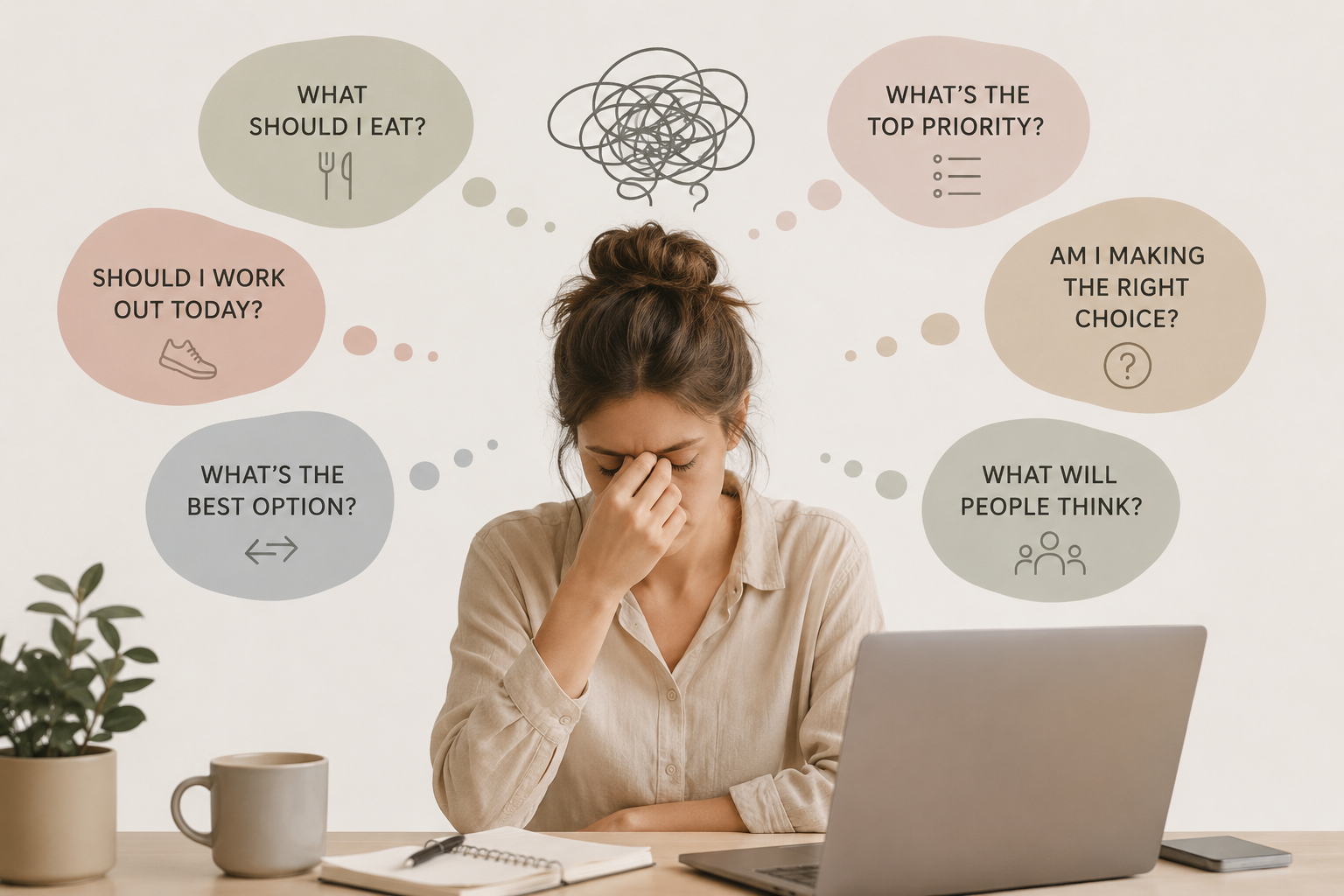
Maybe it started small. You stood in the grocery store for fifteen minutes, unable to choose between two brands of pasta. Or you opened your email, read three messages, and closed the laptop without responding to any of them. Or someone asked you what you wanted for dinner, and the question felt somehow completely unanswerable.
If you've recently left an abusive relationship, this experience might be deeply familiar. And if nobody has named it for you yet: what you're going through is called decision fatigue, and sometimes, when it's more severe, decision paralysis. It is a recognized, documented psychological response. It is not a personal weakness. And it does get better.
WHY YOUR BRAIN LEARNED TO STOP DECIDING
Abuse, whether emotional, physical, verbal, or a combination, is a form of chronic, unpredictable stress. Over time, your nervous system adapts. It learns to stay on high alert, constantly scanning for threat and bracing for the next unpredictable event. One of the ways it does this is by outsourcing decision-making.
In many abusive dynamics, the person being abused is taught, gradually and sometimes invisibly, that their choices are wrong. That their preferences are inconvenient, their instincts unreliable, their judgment flawed. Gaslighting, criticism, ridicule, and control chip away at your confidence in your own perception of reality.
Your nervous system isn't broken. It learned to survive. Now it needs to relearn that you are the one in charge, and that being wrong about which pasta to buy is safe.
So your brain adapts. It stops trusting your own judgment because trusting it had painful consequences. In the relationship, deferring to the other person, even when that felt awful, may have been the only way to avoid an argument, punishment, or withdrawal of affection. Your brain learned: don't decide. Let someone else decide. It's safer that way.
Now that you're out, you're carrying that adaptation with you. Your nervous system hasn't yet received the message that the threat is gone, that you are allowed to make a choice and be wrong about it and have nothing catastrophic happen.
WHAT THIS ACTUALLY LOOKS LIKE
Decision fatigue after abuse can show up in ways that feel embarrassing or confusing, especially if you once considered yourself a decisive person. It might look like:
- Feeling frozen or overwhelmed by choices that seem trivial to others
- Avoiding decisions entirely and hoping circumstances just resolve them
- Asking everyone around you what you should do, and still feeling unsure
- Making a decision and immediately spiraling into doubt and second-guessing
- A physical sense of dread, exhaustion, or anxiety when faced with options
- Difficulty identifying what you want, need, or prefer at all
That last one is particularly common, and particularly painful. Years of having your wants dismissed or overridden can leave you genuinely uncertain what those wants even are. When someone asks "what do you want?" you draw a blank, not because you're being evasive, but because the question has been dangerous for so long that your brain stopped bothering to answer it.
THE EXHAUSTION OF HYPERVIGILANCE
Research on decision-making shows that willpower and cognitive resources are finite; the more decisions you make, the harder each subsequent one becomes. This is well-established even in people who've experienced no trauma at all. Now layer in the fact that survivors of abuse are often in a near-constant state of hypervigilance: their brain is simultaneously doing the ordinary work of navigating daily life and the exhausting work of monitoring for danger, managing anxiety, and processing grief.
There's simply less cognitive bandwidth available for decisions. The tank is already low before you even open your eyes in the morning. This isn't a character flaw or laziness. It's arithmetic.
You are not too sensitive. You are not broken. You are a person running a marathon in a body that was told, for months or years, that it wasn't even allowed to walk.
WHAT ACTUALLY HELPS
Recovery from decision fatigue after abuse is real and possible, but it tends to work differently than advice for ordinary stress-related decision fatigue. The roots go deeper, and the healing needs to reach them.
Start absurdly small
The goal isn't to make big decisions well. It's to rebuild your trust in your own judgment, one tiny win at a time. Choose the restaurant. Pick the movie. Let the small decisions be practice. Notice that you survived. Notice that nothing terrible happened because you preferred Thai food tonight.
Limit the options you're working with
An overwhelming number of choices is genuinely harder for everyone, and much harder for a nervous system already stretched thin. Give yourself permission to narrow the field. Two options instead of ten. A specific category instead of all possibilities. Structure is not weakness; right now, it's scaffolding.
Name your preferences out loud, to yourself
You don't have to know why you like what you like. You just have to practice noticing that you do. Keep a small ongoing list if it helps: things you've enjoyed, things you didn't, things you're curious about. Reclaiming preference is one of the most powerful forms of recovery from coercive control.
Work with a therapist, if you can
Trauma-informed therapy, especially approaches like EMDR, somatic therapy, or trauma-focused CBT, can help your nervous system genuinely update its threat assessments rather than just intellectually understanding that you're safe. Talking through the patterns can help you recognize when you're defaulting to old survival strategies that no longer serve you.
Be patient with the non-linear parts
Some days you'll feel remarkably clear. Others, the fog will be back and you won't be able to choose a podcast. Both are part of the process. Progress in trauma recovery is rarely a straight line upward. It spirals, and revisiting old confusion doesn't mean you've lost the ground you gained.
If you're reading this and recognizing yourself in it: you are not alone, and you are not stuck here permanently. The mind that learned to survive something very hard can also learn, slowly and imperfectly, to trust itself again.
One choice at a time. Whichever pasta you want.
If you're struggling and would like support, the National Domestic Violence Hotline is available 24/7: 1-800-799-7233 or text START to 88788.
This blog is for informational purposes and is not a substitute for professional mental health support.